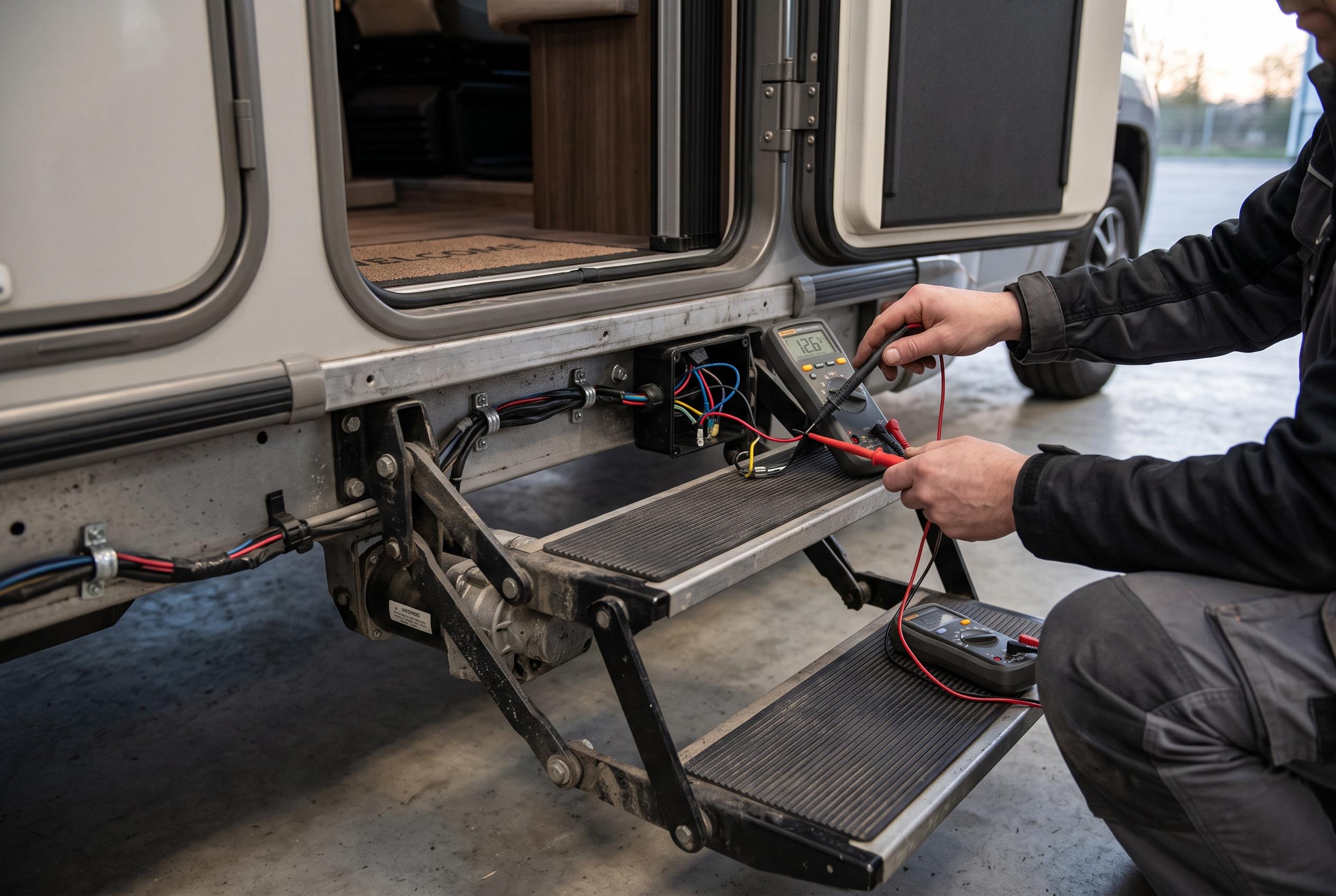

Faulty electric entry steps in RVs can pose safety risks, but a systematic diagnosis approach, focusing on power, grounding, wiring, and mechanical integrity, can ensure safe, reliable operation.
A faulty electric entry step can turn a routine arrival into a safety issue. For many RV owners, the first clue is the same: the door opens, the step should move, and nothing happens. According to Lippert’s support material for Kwikee systems, the correct response is not to start replacing parts at random, but to work through power, ground, wiring, control and mechanical checks in sequence. That approach matters because a weak battery, a poor chassis earth, a bad door switch or a binding linkage can all produce the same outward symptom.
The first task is to identify the step type. Not every RV entry step is a Kwikee electric unit, and the repair path differs sharply between manual fold-down steps, pull-out steps and automatic electric assemblies. Manual and slide-out designs tend to fail mechanically, while electric Kwikee-style steps add a motor, controller, door input and ignition override. Lippert’s manuals and related technical guides stress that the number of treads, the linkage layout and the controller generation all affect parts compatibility, so a motor that looks similar may still be the wrong component.
Kwikee systems do not simply run the motor for a fixed time. The control unit senses current draw and shuts the motor down when the step reaches its travel limit or encounters resistance. That makes the system sensitive to low voltage, corrosion and mechanical drag. Lippert’s documentation, echoed in Tiffin Motorhomes’ Kwikee 47 Series manual, places grounding at the centre of diagnosis and expects a properly charged 12-volt battery to read about 12.6 volts at rest. Clean battery terminals, a sound negative cable and a secure green ground wire are not optional details; they are core parts of the circuit.
A useful next move is to isolate the step from the RV wiring with a four-way pigtail. Lippert identifies the testing connector as Power Gear part 909306000, or Lippert part 369243, and its IMGL testing procedure uses that disconnect to determine whether the fault lies in the step assembly or in the coach wiring. If the step operates normally on an independent battery feed, the motor and controller are probably capable of working and the problem is more likely to be found in the door switch, ignition circuit, fuse, lockout switch or connector. If it still fails, the fault moves downstream to the motor, controller or a mechanical bind.
When the pigtail test does not solve the problem, direct motor testing is the next logical step. Lippert’s procedure bypasses the controller so the motor can be checked on its own with 12-volt power. A motor that runs strongly in both directions is usually serviceable, which shifts attention back to the controller or the rest of the wiring. A motor that stalls, grinds or fails to turn points to a seized or damaged unit, although mechanical binding in the step linkage can produce similar behaviour. The key point is to avoid assuming that a slow or weak response is acceptable; in this context, intermittent operation is a warning sign, not proof of health.
The control unit itself should only be blamed after the other essentials are known to be sound. Lippert’s testing procedure looks for the controller to cut voltage after the step reaches its end stop. If power continues for too long, the controller may be defective, but only after battery condition, grounding, connectors and motor operation have been verified. That distinction is important because a poor ground can mimic controller failure, and a corroded connector can make a healthy assembly appear dead.
Mechanical inspection is equally important. RV Solver and other technical guides on Kwikee troubleshooting note that mud, ice, bent tread supports, worn bushings, cracked brackets and distorted mounting points can all keep a step from moving properly even when the electrics are fine. Lippert’s manuals also describe A, B and C linkage types, which are not interchangeable labels but different geometries and hardware arrangements. The wrong linkage or a mismatched conversion kit can leave the step unreliable even after what appears to be a correct repair. That is why model series, tread count and controller generation all need to be matched before ordering parts.
Replacement decisions should follow the evidence, not the price tag. A motor or conversion kit makes sense when the frame is straight, the linkage is intact and the step fails the direct power test. A full assembly replacement is more appropriate when the frame is bent, the mounting points are worn, the structure is rusted through or multiple major parts would need replacing at once. Lippert’s published material also points out that older pre-IMGL components may not interchange cleanly with newer IMGL and IMGL II systems, so age of the assembly can be as important as visible condition.
Routine maintenance helps prevent the failure in the first place. Kwikee manuals recommend cleaning off mud, salt and road grime before lubricating moving parts such as pivots, bearings, slides and clevis pins. Lippert identifies a moisture- and heat-resistant grease for this purpose and specifically advises against using silicone sprays or WD-40 as the main lubricant, because they do not provide lasting protection. Regular inspection is especially important in coastal, winter-salted or dusty environments, where corrosion and contamination are more aggressive. If the step is working, it still deserves periodic checks, because a slow or noisy step is usually giving advance notice of a deeper problem.
Disclaimer: This content is intended for informational purposes only. Readers are advised to exercise their own judgement, conduct due diligence, or consult a qualified expert before acting on any information provided.