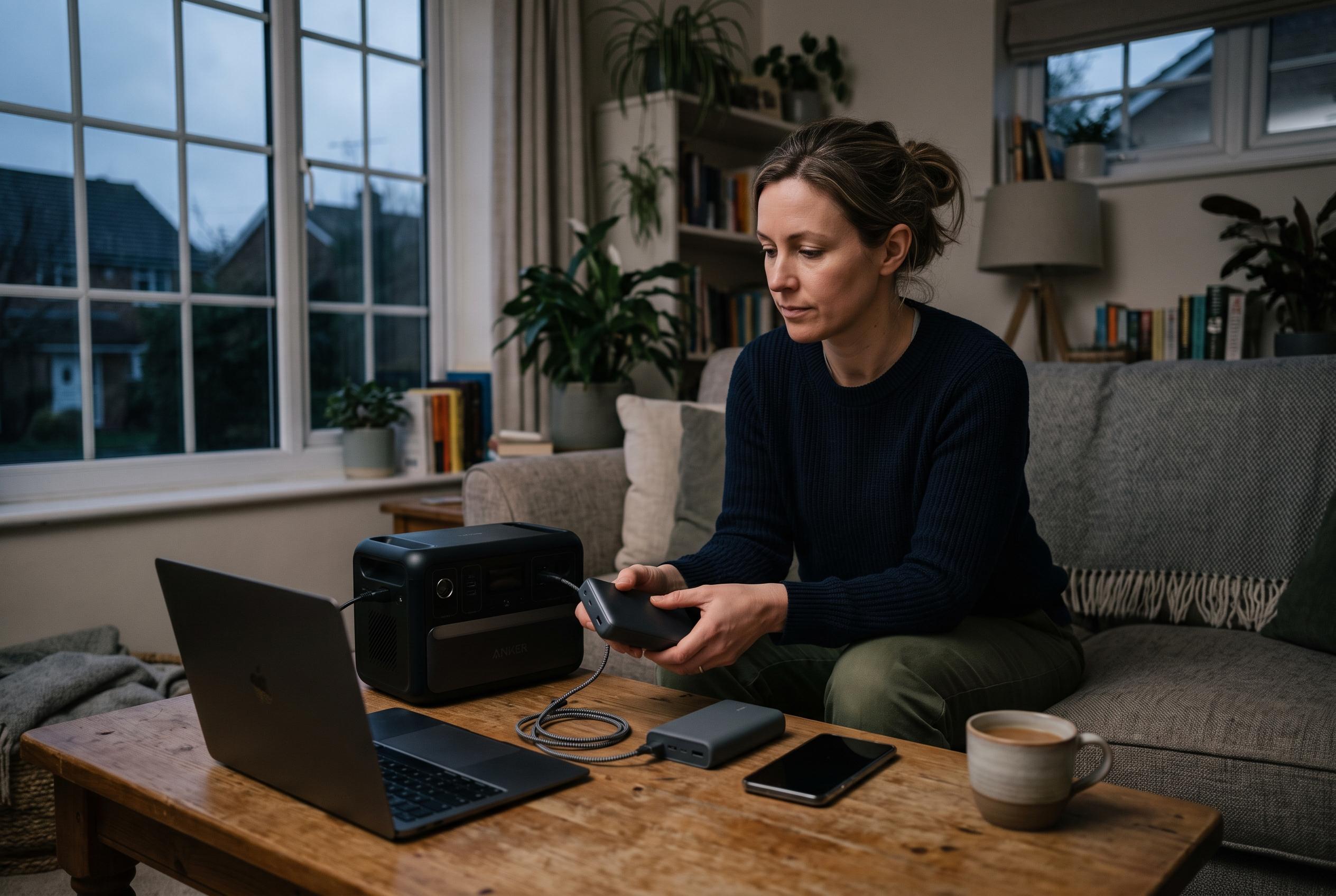

Capacity is only part of the equation when choosing backup power: USB-C Power Delivery, recharge speed, safety and a layered charging plan can matter more than the largest number on the box.
A portable phone charger is one of the simplest emergency purchases a household can make, yet it is also one of the easiest to misunderstand. When the grid fails, a phone quickly shifts from convenience to essential equipment: it becomes a map, torch, weather source, and communications link. Preparedness guidance from REI and other off-grid buying guides makes the same basic point: the right charger is the one that matches your actual use case, not the biggest number on the box.
The first mistake many buyers make is to focus only on milliamp-hours, which can be misleading unless it is paired with output, recharge speed and real-world efficiency. REI explains that capacity should be judged against the devices you intend to power, while practical guidance from Blackout Alpha and other buyer’s guides stresses that usable capacity is always lower than the printed figure because of conversion losses. For most people, a compact power bank suits day-to-day carry, while larger units are better for vehicles, home kits or prolonged outages.
USB-C Power Delivery is now the most important feature to look for in a modern bank. REI notes that faster charging is not just a convenience; it also shortens the time a bank needs to be plugged in, which matters when grid access is intermittent. A bank that can refill quickly is more useful than a larger one that remains empty for hours. In practical terms, that makes a mid-sized power bank with USB-C input and output a stronger choice than an older, higher-capacity model built around outdated ports.
Solar charging is often presented as a complete answer, but the better advice is more restrained. REI’s solar-charger guidance makes clear that portable panels are most effective when they are treated as a way to replenish a separate power bank, not as a direct substitute for one. Gridless World reaches the same conclusion, arguing that solar is useful when paired with stored power, while hand-crank charging is best understood as a last resort rather than a primary source. For outage planning, the sensible approach is layered: store energy first, then add a renewable way to replace it.
Portable power stations sit above ordinary power banks in both price and capability. REI distinguishes them clearly from smaller chargers, and current buying guides from WalkingSolar and UDPOWER emphasise the same decision points: battery capacity, continuous output and solar input. These units are not pocket gear. They are for households that need to run more than phones, such as tablets, lights, laptops or medical devices. In that setting, the extra size and weight are the trade-off for much greater resilience.
Safety matters as much as capacity. The strongest advice across the buying guides is to choose reputable products, check for clear specifications and avoid cheap no-name units with exaggerated claims. Blackout Alpha highlights the importance of quality markers, while the more general guidance from REI and related sources points to the value of matching battery chemistry and output to the intended load. For any charger that may sit close to your body or in a vehicle, physical toughness, proper circuitry and honest labelling are not optional extras.
A charger is only useful if it is maintained. Off-grid advice from Gridless World stresses that preparedness tools are most valuable when they are simple enough to be used regularly, not forgotten in a drawer. That means keeping banks partially charged, checking them on a schedule and storing the correct cables alongside them. The same principle applies to power stations and solar gear: if the equipment is hard to deploy, it will be far less useful in a real outage.
The most reliable plan is layered rather than singular. A small bank in an everyday bag handles short interruptions. Larger banks support household or vehicle use. Solar panels extend runtime when sunlight is available. A power station fills the gap when a family needs more than phones. The practical lesson from the source material is consistent: do not buy for a worst-case scenario alone, and do not buy for convenience alone. Buy for the way you actually live, then keep the system charged and ready.
Disclaimer: This content is intended for informational purposes only. Readers are advised to exercise their own judgement, conduct due diligence, or consult a qualified expert before acting on any information provided.