

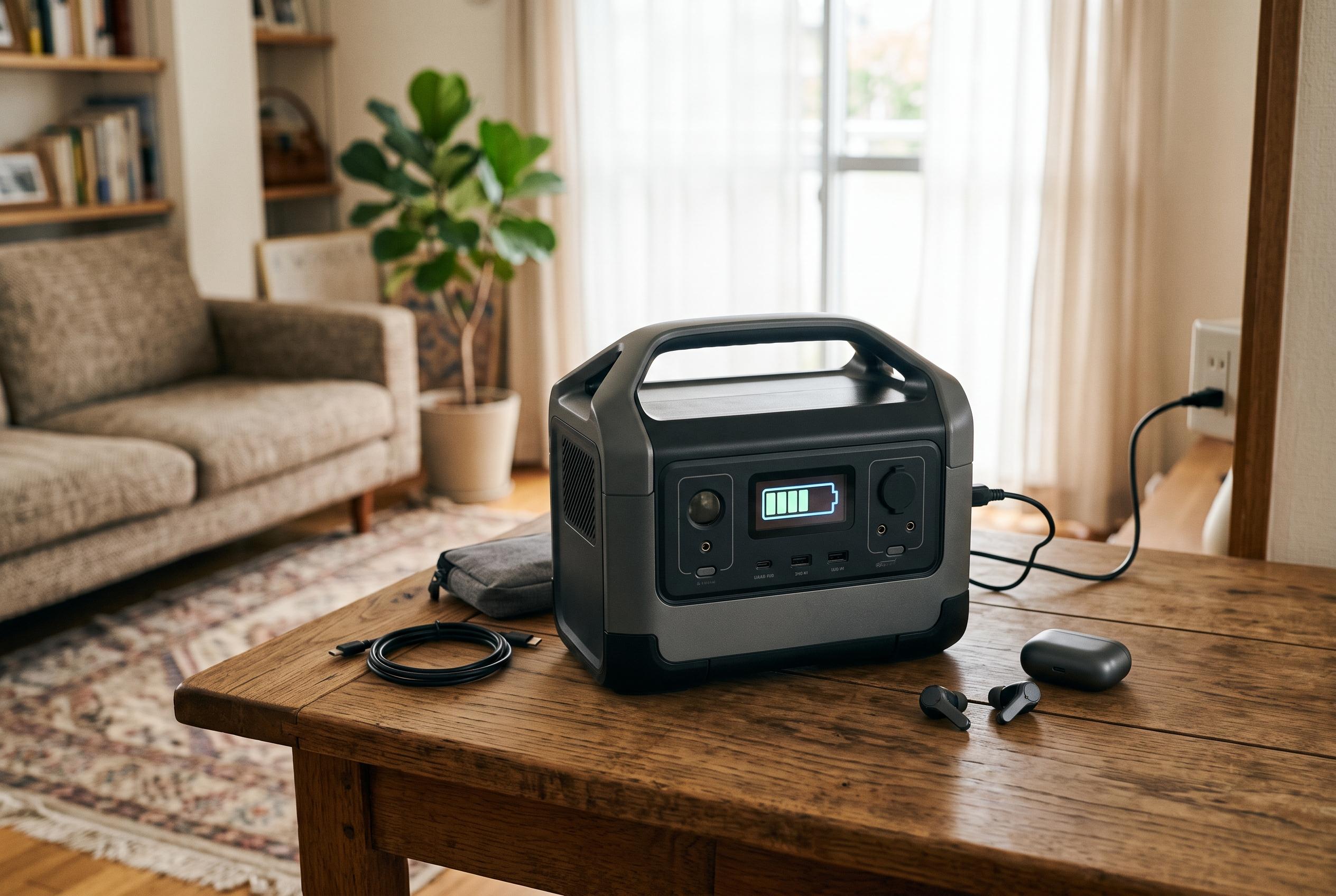

A power station that appears unable to reach a full charge may be balancing its cells, responding to unstable mains voltage or recalibrating its battery gauge rather than failing.
Portable power stations have become a normal part of household resilience in Ukraine, but their behaviour can still be confusing. One of the most common concerns is simple enough: the unit remains plugged in for hours, yet the display never seems to reach a true full charge. That does not always mean the battery is failing. In many cases, the explanation lies in how the battery management system, or BMS, measures charge, protects the cells and finishes the last part of the charging cycle.
Most modern stations use either lithium-ion or lithium iron phosphate battery packs made up of many individual cells. Those cells do not charge in a perfectly uniform way, so the BMS acts as the control layer that monitors voltage, current and temperature. Industry guidance on BMS calibration says that inaccurate readings can cause safety risks, including overheating or other battery faults, which is why these systems are designed to intervene before damage occurs. The same control logic also explains why charging slows dramatically near the top end of the battery’s range, because the system is balancing the cells rather than simply pushing energy in as quickly as possible.
That final phase can look as if nothing is happening, even when the battery is behaving normally. The charge level may rise quickly at first, then crawl from around 90% upwards while the BMS equalises the cells. Guides on portable stations and lithium battery systems say this is a routine part of the process, and that apparent delays near the top of the range are often linked to balancing or to the state-of-charge estimate drifting out of line with reality.
Another factor is the household power supply itself. After blackouts or unstable grid conditions, voltage can fall well below the usual level, and protection systems may reduce charging current or stop charging altogether. In practical terms, that means a station connected to a weak mains supply may appear reluctant to finish charging, even though the battery and charger are working within their safety limits.
Manufacturers commonly recommend a full BMS calibration every few months if the charge display becomes unreliable. The usual method is to remove any upper or lower charge limits in the companion app, discharge the station fully with a moderate load, then charge it back to the end and leave it connected until the input power reading falls to zero. Specialist BMS guides describe this kind of full cycle as a way to correct sensor drift and restore a more accurate state-of-charge reading. If the display still behaves erratically after that, the fault is more likely to be hardware-related than software-related.
For owners, the practical takeaway is straightforward: a station that lingers at 99% is not automatically damaged, and the last stage of charging is often the slowest by design. But if the device repeatedly refuses to complete a full charge, or if it does so only when the grid voltage is stable, the problem may lie outside the battery itself. In that situation, the safest option is to avoid opening the unit and have it checked by a qualified technician.
Disclaimer: This content is intended for informational purposes only. Readers are advised to exercise their own judgement, conduct due diligence, or consult a qualified expert before acting on any information provided.



