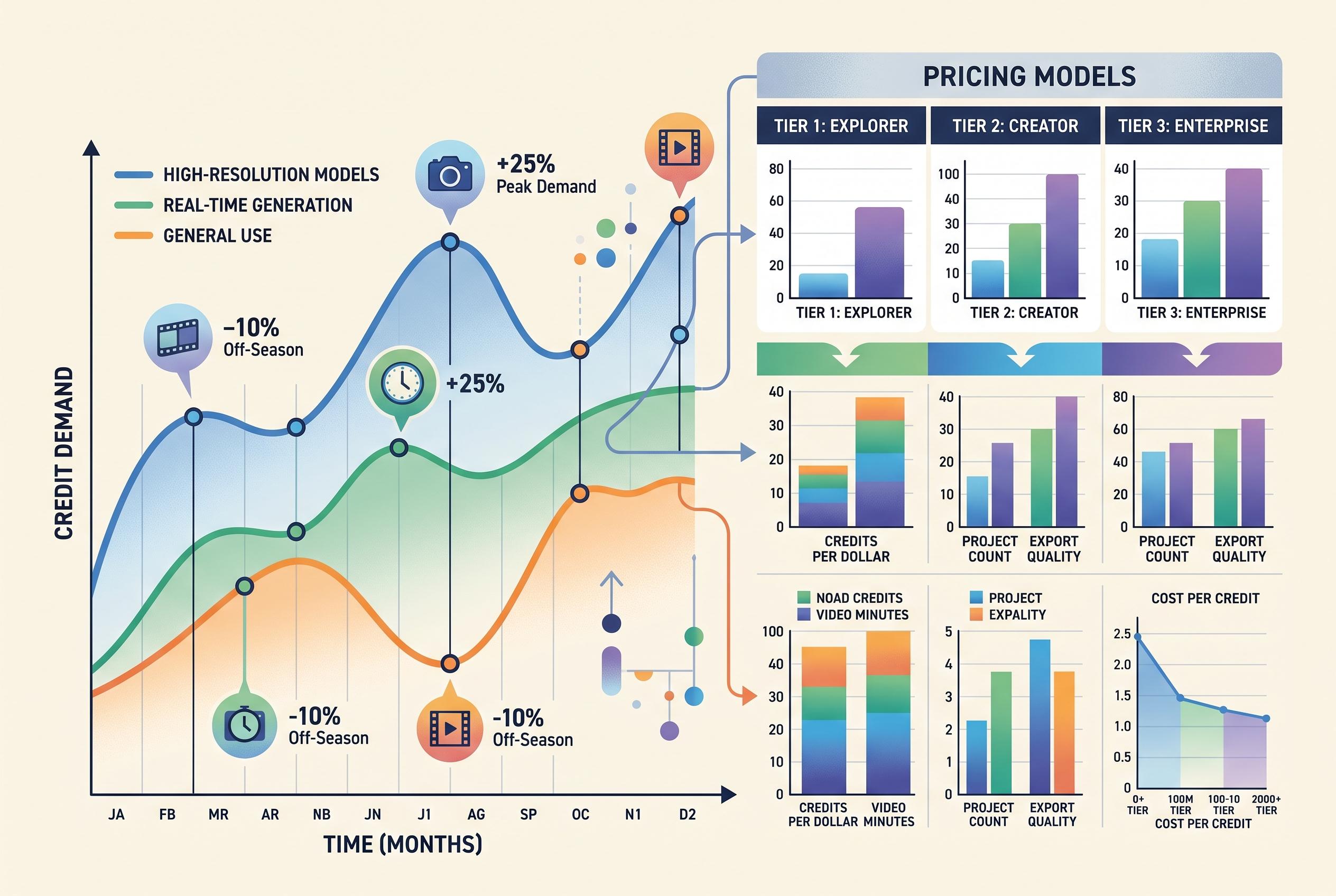

As image-to-video AI services grow, selecting the right credit plan hinges on understanding demand patterns, with one-off packs offering a better fit for irregular workflows amid evolving pricing models and watermark removal concerns.
For buyers of image-to-video tools, the main risk is often not the listed price but the pattern of use after the first campaign. A package that looks inexpensive can become inefficient if demand drops after an initial burst, leaving credits unused and budgets tied to a plan that no longer matches the workflow. The central question is therefore not whether the software can generate motion from still images, but whether its credit model fits a realistic forecast of demand.
The service in question offers three broad routes: a free entry point for testing, a one-off credit pack, and monthly subscriptions that reduce the apparent cost per generation in exchange for a continuing commitment. That structure is common across the sector. Image To Video, ClipTrend, Imagetovideoai.pro and Lario all mix subscriptions with credit-based access, while some providers also offer free starter credits or pay-as-you-go packs. Segmind goes further with token-based billing, showing that the market is not converging on a single pricing logic, but on several different ways of charging for similar output.
That makes demand volatility the real procurement issue. A team may need a large batch of clips for a launch, then very little for several weeks. In that setting, a monthly balance can appear efficient on paper but behave badly in practice if the brief changes, approvals slip, or the campaign calendar thins out. The better comparison is not simply price per credit, but how long the credits remain useful if production pauses.
The one-time pack is the clearest fit for uneven demand. According to the pricing information, 200 credits cost $9.99 and do not expire, which makes them easier to defend for pilots, client tests or irregular projects. By contrast, the monthly plans offer lower estimated unit costs only when a team can reliably consume the allowance within the billing period. That trade-off matters for agencies and product teams that cannot yet prove a steady output forecast.
Watermark removal also changes the buying decision. Free generation is useful for evaluation, but it is not the same as a finished deliverable. On this service, each successful generation consumes 10 credits and produces a watermark-free video, while falling below that threshold pushes the user back to the free tier with a watermark. For anyone preparing assets for a client, publication or product page, that distinction is operational rather than cosmetic.
The procurement test should therefore be simple and strict: use the same still image and brief, then check whether the subject stays recognisable, whether the motion supports the message and whether the file is suitable for delivery. A small sample is usually enough if the pass criteria are clear. As the company states, completed generations are treated as final digital services and sales are non-refundable, which makes approval discipline more important than a low headline price.
Seen in that light, the sensible first purchase is the one that matches uncertainty. The free route helps with exploration. A one-off pack suits teams with irregular demand and a need for credits that do not expire. Standard or Pro only becomes persuasive when the queue is predictable, the team needs regular watermark-free output and the monthly commitment can be justified by a forecast rather than optimism.
Disclaimer: This content is intended for informational purposes only. Readers are advised to exercise their own judgement, conduct due diligence, or consult a qualified expert before acting on any information provided.