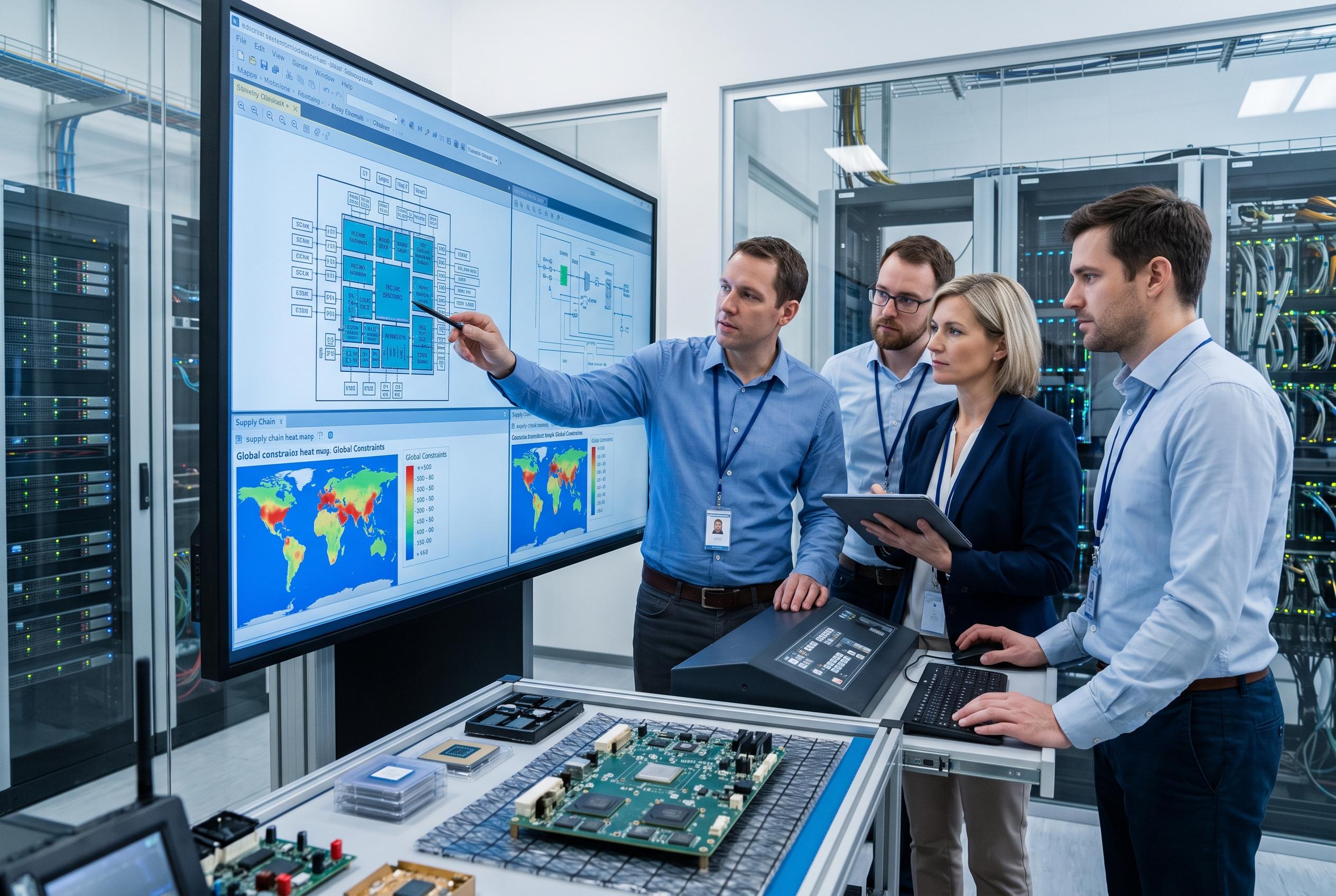

The surge in AI development is pushing the semiconductor industry to its limits, revealing vulnerabilities in supply chains reliant on concentrated, specialised suppliers and exposing geopolitical and economic risks amid rising costs and capacity constraints.
Artificial intelligence is often described as a software breakthrough, but the real constraint is physical. The latest reporting on the semiconductor industry makes clear that AI systems depend on a dense industrial network of chipmakers, equipment suppliers, raw materials, logistics and power. Bloomberg’s recent video on the subject, along with related coverage, shows that the AI boom is now testing the limits of a supply chain built for speed, precision and scale.
One of the sharpest examples is ASML. Its extreme ultraviolet lithography systems sit at the centre of advanced chipmaking, yet they are also expensive, scarce and difficult to replace. That makes ASML a reminder that a supplier’s strategic value is not measured by spend alone. In semiconductors, a single highly specialised vendor can determine whether an entire production roadmap stays on track.
The same logic applies to TSMC, whose dominance in advanced fabrication has become both an industrial strength and a geopolitical risk. Reporting on the company’s plans and on wider industry commentary highlights the extent to which the world’s most advanced chips are still concentrated in Taiwan. That concentration has encouraged governments and companies to push for more capacity elsewhere, especially in the United States, where Arizona has become a major test case for semiconductor reshoring.
But building a fab is not the same as building a supply ecosystem. A working plant needs equipment makers, chemicals, gases, technicians, utilities, water, maintenance and a trained workforce. The industry’s recent expansion efforts underline a basic truth: semiconductor capacity cannot be switched on quickly, no matter how urgent demand becomes. Manufacturing know-how, supplier development and operational experience all take years to accumulate.
The pressure is not limited to the most advanced AI processors. Memory chips are also becoming a bottleneck. Axios reported that AI demand has driven a sharp rise in memory prices, a reversal of a long-standing trend of cheaper DRAM. That increase is rippling through consumer electronics, cloud infrastructure and other hardware, while large technology firms lock in long-term supply agreements to secure capacity. The result is a form of chip inflation that is beginning to affect broader technology costs.
At the same time, policy concerns are reshaping how chip supply chains are viewed. According to Tom’s Hardware, U.S. Representative John Moolenaar has urged enforcement of a Biden-era rule requiring foundries to verify customer identities and end uses before shipping chips made with advanced American technology. The issue matters because the semiconductor chain is not only commercial; it is also a point of control, compliance and national security.
Cost pressures are complicating the industry’s next investment cycle. Bloomberg reported that TSMC has delayed adopting ASML’s most advanced high numerical aperture EUV machines until 2029 because of their price. Winbuzzer separately reported that ASML sees room to raise prices, while TSMC is pushing back. Together, those accounts suggest a familiar tension: the industry needs ever more advanced tools, but the economics of deploying them are becoming harder to justify.
The broader lesson is that AI is forcing a rethink of supply chain strategy. The companies that design the smartest models will still depend on the firms that can manufacture the chips, move the materials and finance the infrastructure. In that sense, the AI race is also a competition between supply chains. The organisations that manage concentration, capacity and critical suppliers best will shape how fast the technology can really grow.
Disclaimer: This content is intended for informational purposes only. Readers are advised to exercise their own judgement, conduct due diligence, or consult a qualified expert before acting on any information provided.