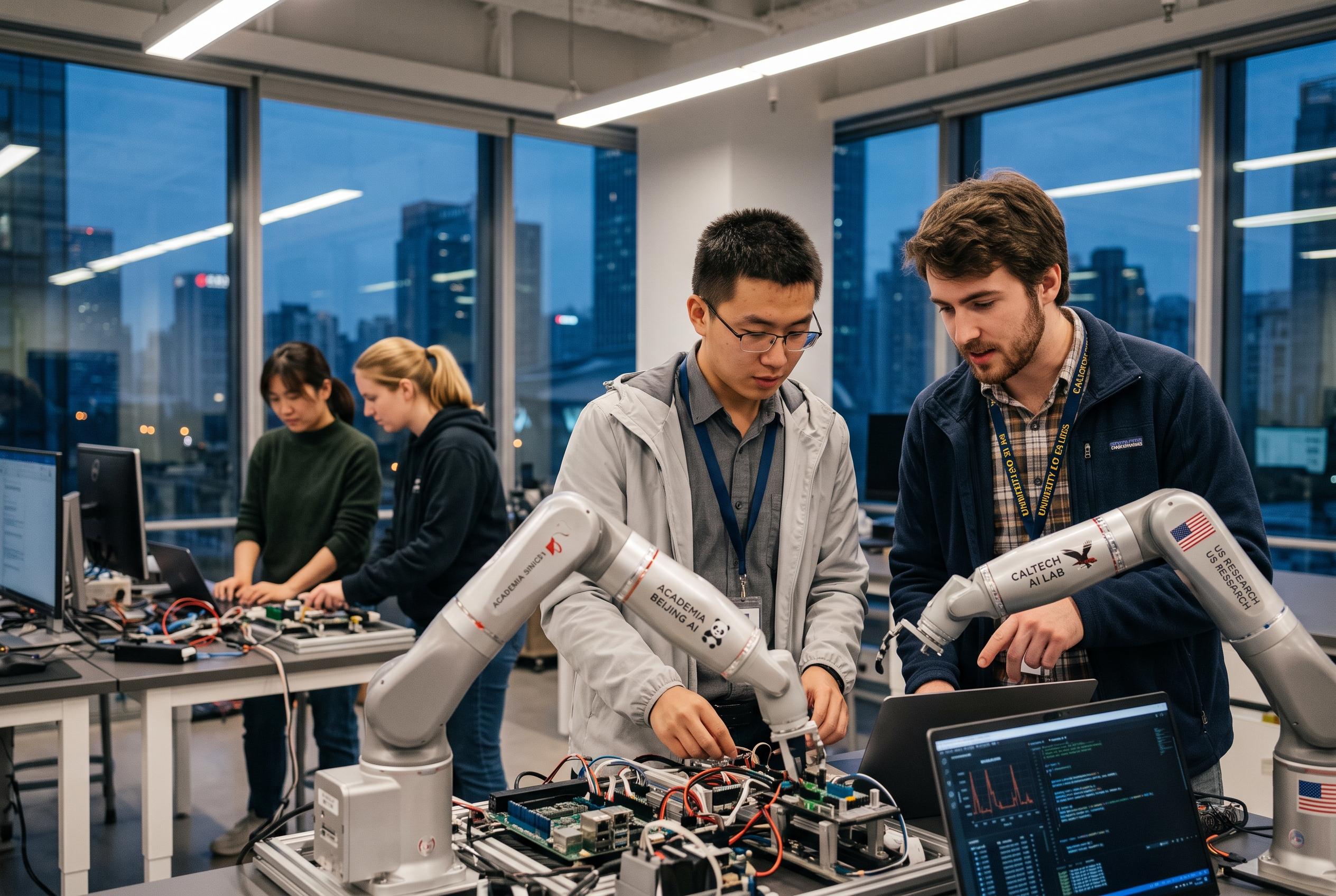

China is closing the artificial intelligence development gap with the United States faster than anticipated, prompting a reassessment of American technological dominance amid increasing Chinese advancements in model quality and market reach.
China is narrowing the artificial intelligence gap with the United States at a pace that is forcing investors, policymakers and technology executives to reconsider how durable America’s lead really is. A report highlighted by CNBC says the contest is becoming a far more balanced rivalry, with Chinese firms advancing quickly in model development, deployment and commercial adoption.
That shift does not mean the United States has lost its edge. American companies still dominate advanced chip design, cloud infrastructure and AI funding. But the latest assessments suggest China has compressed the development gap sharply. According to a CLSA report cited by the South China Morning Post, the lag has shrunk to about three months from more than a year, even though China remains several years behind in advanced semiconductor technology.
Stanford University’s latest AI Index report points in the same direction. China has been catching up not only in model quality but also in overall competitiveness, with leading systems in both countries repeatedly trading top positions since early 2025. The report also notes that, despite a large U.S. investment advantage, the performance difference between top American and Chinese models has effectively closed.
Market data is also showing the narrowing divide. An analysis by The DONG-A ILBO, based on OpenRouter data, found that the United States still led global AI usage with a 50.7% share, compared with China’s 34.4%. But the gap has narrowed dramatically, from 43.3 percentage points a year earlier to 16.3 points, suggesting that China’s reach in the AI market is expanding quickly.
China’s progress is being driven by a mix of state support, a large domestic market, growing technical talent and rapid product iteration. Researchers in China have argued that a more aggressive willingness to take risks is helping the sector move faster, even as the country still lacks the most advanced chipmaking tools needed for the most compute-intensive AI systems. That hardware constraint remains central, because the most capable AI models depend heavily on high-end semiconductors.
The strategic contest is therefore increasingly tied to chips as much as software. Washington’s export controls are meant to slow China’s access to the most advanced technology, but they are also encouraging Beijing to build domestic alternatives and reduce dependence on foreign suppliers. That creates a longer-term question for the United States: whether restrictions will preserve its lead or accelerate Chinese self-sufficiency.
For now, the evidence suggests a race that is no longer one-sided. The United States still has the broader industrial and financial advantage, but China is moving fast enough that the global AI competition now looks less like a sprint with a clear frontrunner and more like a prolonged contest that could reshape computing, manufacturing and national security for years to come.
Disclaimer: This content is intended for informational purposes only. Readers are advised to exercise their own judgement, conduct due diligence, or consult a qualified expert before acting on any information provided.