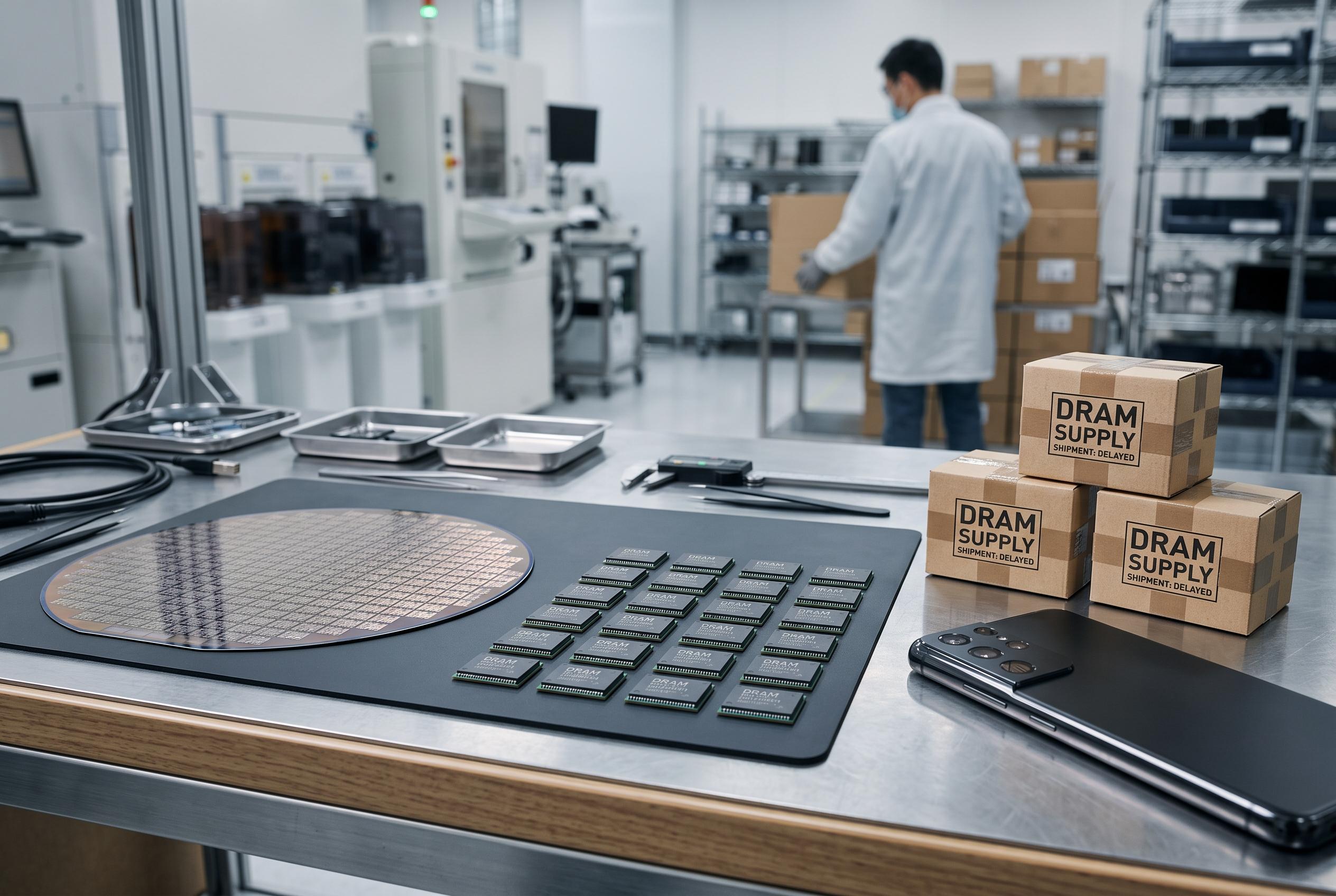

A worldwide scarcity of memory chips may constrain the production and increase the price of Apple’s upcoming flagship, with supply chain delays and higher costs potentially impacting debut volumes and pricing strategies.
Apple’s next flagship iPhone could face a constrained launch if the global DRAM squeeze worsens, with reports suggesting the iPhone 18 Pro may arrive in smaller initial volumes than usual. Industry tracking cited by TechGenyz and others points to a shortage of memory chips that is already complicating production planning for premium devices, where higher capacity and faster bandwidth are increasingly tied to on-device artificial intelligence features.
Tom’s Hardware reported that roughly $1 billion worth of Apple processor wafers are sitting in packaging queues because of DRAM constraints, creating a bottleneck around final assembly of the A20 Pro and C2 chips. The report said Apple draws most of its DRAM from Micron, with additional supply from SK Hynix and Samsung, but that long-term customer commitments elsewhere have narrowed availability. Apple and its manufacturing partners are still said to be confident about meeting first-wave demand, yet the risk appears to rise after launch if the shortage persists.
The pressure is not unique to Apple, but the company’s Pro models are especially exposed because they are expected to carry the most demanding AI workloads. MacRumors reported that global memory scarcity is forcing some manufacturers to rethink specifications, delay launches or downgrade configurations. The same report said large cloud and chip companies, including Nvidia, are bidding aggressively for scarce DRAM and high-bandwidth memory, while AI data centres are soaking up much of the industry’s spare capacity.
Apple has reportedly explored adding China’s CXMT as an alternative supplier, but PhoneArena said that plan has not yet solved the problem. The new Wafer-Level Multi-Chip Module packaging required for the A20 Pro depends on close coordination between memory vendors and Apple’s chip teams, and Samsung and SK Hynix have had years to build that process. CXMT is still relatively new to the arrangement and is mainly testing memory for devices sold in China, which means it is unlikely to be ready in time for a broad iPhone 18 Pro debut.
Rising component costs are also feeding speculation that Apple may have to pass some of the strain on to customers. MacRumors reported in June that Apple is already facing price pressure from more expensive memory, with the iPhone 18 Pro potentially starting at $1,399. Later reporting from the same site said Counterpoint Research expects the iPhone 18 Pro Max bill of materials to rise by nearly $300 from the iPhone 17 Pro Max, with NAND flash and DRAM both climbing sharply as manufacturers prioritise memory for AI hardware. If Apple cannot secure enough supply quickly, the most likely outcomes are tighter early stock, slower delivery times and a stronger chance of launch pricing moving higher.
Disclaimer: This content is intended for informational purposes only. Readers are advised to exercise their own judgement, conduct due diligence, or consult a qualified expert before acting on any information provided.