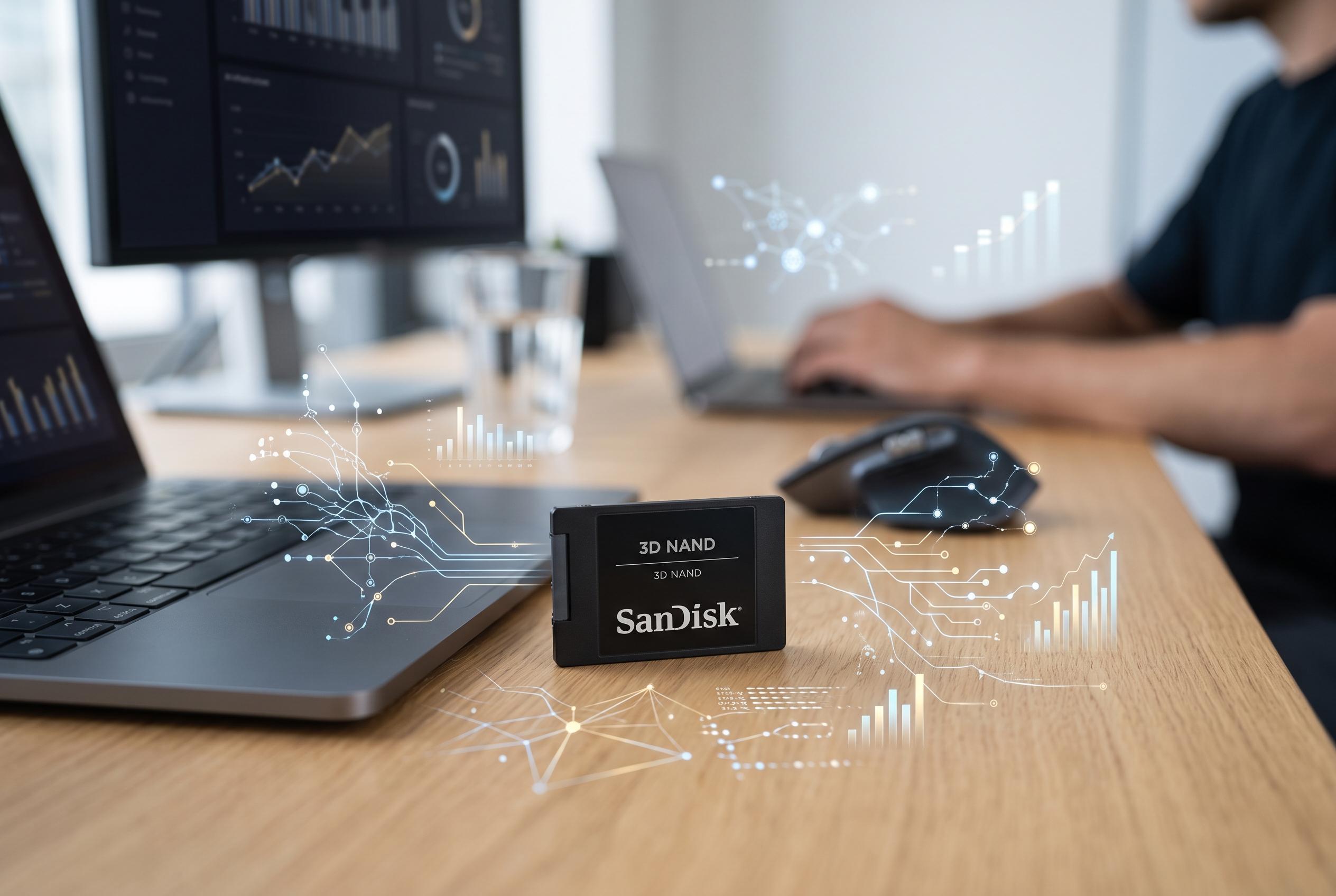

Sandisk’s shares continue to climb after JPMorgan’s upgraded outlook and news of multi-year customer agreements, signalling a transformative shift in the memory sector driven by AI infrastructure needs.
Sandisk shares extended their powerful rally on Tuesday after JPMorgan said the stock still had room to rise, even after a gain of more than 543% this year. The bank lifted its rating to “overweight” from “neutral” and set a $2,250 target, arguing that the company is unusually well placed to benefit from the structural jump in NAND demand tied to inference-heavy artificial intelligence. In pre-market trading, the stock climbed further to $1,620.13 after closing the previous session 13.67% higher. The move came after Sandisk’s investor day, where the company outlined a new business model built around clearer pricing mechanisms and upfront commitments from key customers.
JP Morgan said those long-term agreements could help smooth Sandisk’s historically cyclical earnings profile. The bank pointed to eight contracts under the new model, with a minimum total contract value of about $94 billion and a weighted average term of more than four years. That structure is designed to support higher, more stable margins by tying pricing more closely to customer commitments rather than spot market swings.
The bullish view on Sandisk is part of a broader reassessment of the memory market by Wall Street. Morgan Stanley recently raised its target for Sandisk to $1,750 from $1,100, saying supply remains tight and that DRAM has become the main bottleneck in AI infrastructure build-out. Bernstein went further, lifting its target to $3,000 from $1,700 and highlighting a shift towards longer-term supply agreements with fixed or range-bound pricing and upfront financial commitments.
Other brokerages have also turned more constructive. Mizuho increased its Sandisk target to $1,825, while Barclays raised its target to $2,300 and said multi-year customer deals are improving revenue visibility in a sector long defined by volatility. The common thread across the notes is the same: AI demand is no longer being treated as a short-lived spike, but as a force that may keep NAND and broader memory supply tight for years.
Disclaimer: This content is intended for informational purposes only. Readers are advised to exercise their own judgement, conduct due diligence, or consult a qualified expert before acting on any information provided.